
My Ruby Bike: Stella’s Story – IDDP 2025
Stella’s journey with My Ruby Bike shows what disability inclusion looks like in real life: practical support, the right adaptations and the confidence that grows when people are given the conditions they need to thrive.
International Day of Disabled People 2025 – Bikeworks
Every International Day of Disabled People invites us to reflect on what an inclusive society should look like. For Bikeworks, inclusion isn’t an abstract theme or a set of aspirations. It is lived, practical, everyday work.
Stella’s journey with My Ruby Bike shows exactly what inclusion means — not in theory, but in motion. Her story is one of confidence, mobility, joy, and identity, and it reflects something bigger: how the right adaptations, the right support, and the right environment can transform what people believe is possible for themselves.
How it began
In 2022, a chance encounter with Claire from For Brian opened a door for Stella. Claire introduced her to Bikeworks, and she came to her first All Ability Club session at Little Wormwood Scrubs not quite knowing what to expect.
That first session gave her something simple but important: a safe place to try cycling in a way that worked for her. Starting on a trike offered stability, space and time so she could feel comfortable and begin exploring what cycling could mean in her life.
It was also where she met one of our instructors who would later become her Buddy for RideLondon. Stella often describes the people around her, family, friends, mechanics and instructors, as “cogs in the wheel of my life,” each playing a part in helping her move forward.
At Bikeworks, we see this echoed every day. Inclusion is not created by one person or one moment. It happens when the right environment, equipment and support come together so someone can take the next step with confidence.
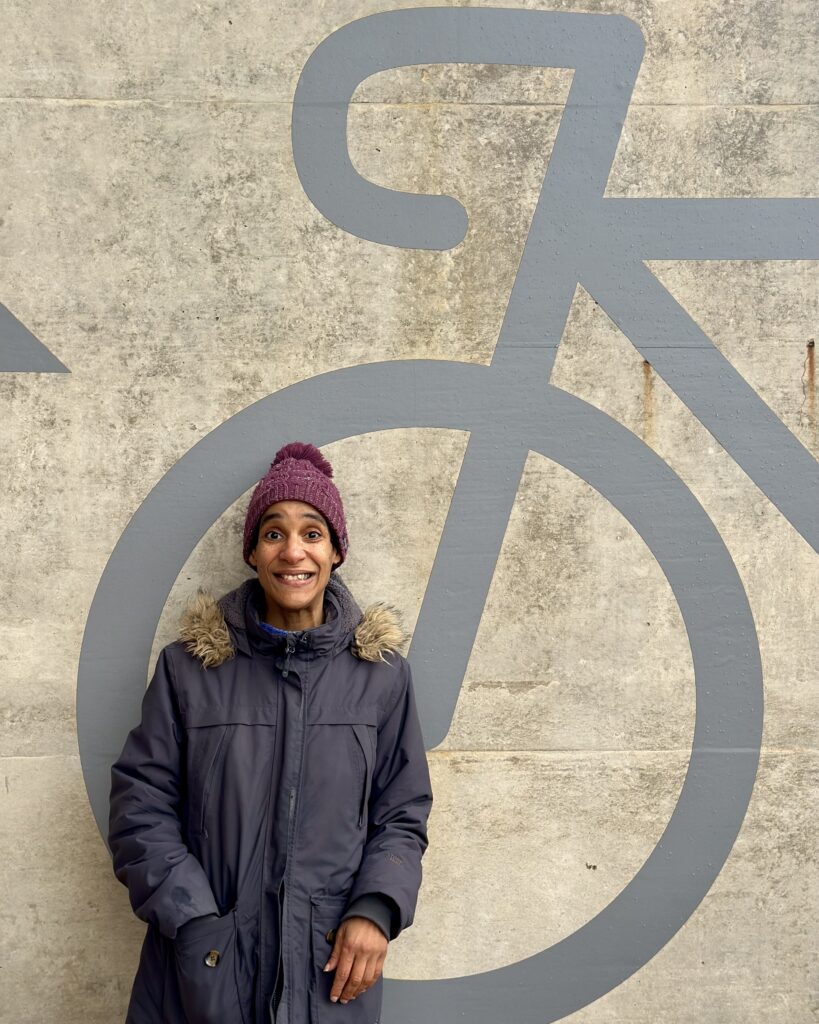
Falling in love with cycling
From that early trike session, Stella’s confidence began to build. During the school holidays she travelled to the Bush Hill Park All Ability Club to keep practising and to spend more time on a cycle that felt safe and familiar.
As her interest grew, she wanted to understand not only how to ride but how to look after a bike properly. She attended a beginners’ maintenance course at the Velodrome with her son Eric, learning how to check her wheels, make simple adjustments and understand her cycle more fully. For Stella, these sessions were about gaining confidence and knowing she could look after her bike.
She continued building her road awareness skills with her Bikeworks instructor, gaining confidence in positioning, communication and navigating different environments.
Then came the moment everything changed.
At Family Bike Club, where she rented a cycle to prepare for RideLondon, Stella found the bike that felt like hers. It was a deep purple model with a bell placed on the right so she could use it comfortably with her non paralysed hand. She immediately called it My Ruby Bike. As she says:
“When I saw my Ruby Bike, it was love at first sight.”
This was not just an emotional reaction. It was recognition. The bike matched her mobility, her strength and her personality. Small details, such as the position of the bell and the stability of the frame, showed her that this cycle was truly suited to her.
In Stella’s words, “My Ruby Bike” is a catalyst that encourages her to keep going and try new things.
Taking on RideLondon – twice
RideLondon is one of the largest closed road cycling events in the country. Tens of thousands of riders take part, from complete beginners to experienced club cyclists, covering distances that can reach one hundred miles. It is not a simple weekend ride.
Stella has now completed RideLondon twice. Before her journey with Bikeworks she would never have imagined taking part, let alone completing the route.
The 2024 ride stands out. The challenge for Stella was not just the distance, it was the logistics of getting Ruby to the start line. For many disabled riders, getting to the start line can be more challenging than the ride itself. Stella asked her son Eric to take her bike in for her. Waking at dawn, and with a bit of encouragement, he made sure Ruby was there so Stella could focus on preparing for what she describes as the biggest cycling day of her life.
Large group events can be difficult for cyclists who need more space and predictability on the road. Throughout the event, a Bikeworks instructor stayed alongside Stella, creating room when groups swept past, guiding her hand to change gears, adjusting the bell, checking her chain and helping her manage the intensity of the day.
In Stella’s words, “Without a Buddy like that, it would not have been possible.”
This is what inclusive cycling looks like in practice. It is not about placing the burden on the individual in settings that do not meet their needs. It is about removing the barriers so people can take part safely and with confidence.

Cycling every day
Today, Stella cycles to work most days, travelling through Enfield parks, along cycle lanes and beside the canals. What began as a way to practise has become part of her everyday life.
She rides to the gym.
She rides for pleasure.
She rides with women from the Breeze network.
She travels by train to visit friends and cycles home along the canal.
Stella jokes that it must be love, because she carries Ruby up three flights of stairs to her flat.
There was a time when she cycled a Fun2Go tandem to work. The cycle became a familiar sight on local streets, with people calling out encouragement and waving as she passed. The visibility mattered. As Stella says:
“The Fun2Go warmed people to me before I even said a word.”
This is what inclusion looks like in practice: people being welcomed in everyday spaces without explanation or justification.

Using cycling to make change
Stella’s cycling has grown beyond transport. She took part in the Ride for Palestine, joining others to raise money for Gaza Sunbirds, a para cycling organisation that supports disabled athletes and provides humanitarian assistance.
What stood out to her was the mix of people taking part. Cyclists of different levels supported one another throughout the ride, creating a sense of community and shared purpose. For Stella, it was a meaningful experience that expanded her sense of what cycling groups can do when people come together.
Why Stella’s story matters – to her, to Bikeworks, and to the wider system
Stella’s story is personal, but it also shows the wider realities of inclusion in practice.
Inclusive cycling is not simply about equipment. It is about dignity, choice and the confidence that comes from having the right set up and the right support.
Adaptations remove barriers, not ambition. Something as small as a bell placed on the right side can be the difference between anxiety and freedom.
Support from instructors matters, not through heroics, but through steady guidance, clarity and trust built over time.
The impact goes far beyond cycling. Stella now travels by train with confidence, without worrying about how others might view her disabilities. She feels more able in her work, her social life and her community.
Before Ruby, Stella describes herself as a worrier. Now, she describes herself as a warrior.
Her experience shows what inclusive cycling really looks like. It is a bell on the right side of the handlebars, a Buddy riding at your shoulder in a crowded event, a bike you are willing to carry up three flights of stairs, a community that waves as you pass on a Fun2Go.
For Bikeworks, Stella’s journey is a reminder of why we keep investing in neighbourhood hubs, adaptive fleets and local partnerships, and why creating these conditions matters if we are serious about inclusion.

Our message for IDDP 2025
The official theme focuses on “disability-inclusive societies.”
Stella’s story shows what that really looks like in practice.
It is practical.
It is relational.
It is planned and intentional.
It is built through the everyday removal of barriers.
Inclusion is not a day on the calendar or a line in a strategy.
It is action — repeated, consistent and accountable.
Stories like Stella’s do not happen by accident, and they do not happen everywhere. They happen when investment is made, when adaptive fleets are funded, when neighbourhood hubs exist, and when the workforce is supported to deliver inclusive cycling consistently and safely.
These conditions are essential, not optional, if we are serious about disability-inclusive societies.
Right now, they are fragile. They rely on short-term funding cycles, one-year grants and the goodwill of organisations asked to do more with less.
If we want what Stella has experienced to be possible for many more people, investment must match the ambition.
Investment in local hubs.
Investment in adaptive fleets.
Investment in the instructors and community partners who make inclusion possible.
Investment that recognises this as a right, not a bonus.
Because when these conditions are in place, inclusion stops being an aspiration and becomes an everyday reality.
Join Our Journey
We celebrate Stella’s courage, determination and joy.
We celebrate the relationships, adaptations and support that made her cycling possible.
And we are committed to creating a world where what Stella has found with Ruby is available to anyone who needs it.
Join Our Journey.
This is inclusive cycling, and this is why it matters.