
Bikeworks at 20: Disability, Cycling and What Makes Riding Possible
Twenty years of inclusive cycling has taught us something important: the cycle is only one part of access.
The right cycle can completely change what is possible. But so can the chance to try different cycles, somewhere to ride regularly, people who understand how different designs work, and streets and public spaces that accommodate a much wider range of riders and ways of moving.
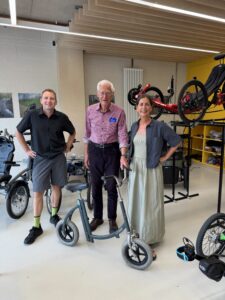
The all-important relationship between the person, the cycle and the environment they are riding in was at the heart of a conversation at our Inclusive Cycling Hub at Queen Elizabeth Olympic Park, when Professor Glen B. Norcliffe joined Bikeworks Co-Founders Zoe Portlock and Jim Blakemore.
Glen is Professor Emeritus of Environmental and Urban Change at York University in Toronto. His research explores the relationship between disability and cycling technology: how cycles have changed over centuries, who has shaped those changes, and what happens when cycling infrastructure and systems are designed around too narrow an idea of the rider and the cycle.
The cycle itself can change
One of the most compelling ideas in Glen’s research is that disabled people have not simply received cycles designed for them. They have also played a part in shaping the technology.
His research traces the relationship between disability and cycling back centuries, showing how riders, families, mechanics and manufacturers have identified problems, exchanged ideas, tested designs and adapted cycles around what people actually wanted and needed to do.
That history challenges the idea of a standard bicycle designed for a standard body, with specialist solutions added later for everyone else.
Cycle design has evolved because riders have needed different things from it.
Handcycles offer another way to generate power. Tricycles can provide greater stability. Side by side cycles change the experience of riding with another person. Electric assistance can make distance, hills or fatigue more manageable. The cycle itself is not fixed. It can be adapted and rethought.
And the reasons for riding are just as varied: getting somewhere, being active, spending time with other people, enjoying the experience of cycling, or simply making it part of everyday life.
We see that every week at Bikeworks.
For us, the question is reframed. Rather than asking, “How do we get this person onto this cycle?”, we ask:
“What does this person want cycling to make possible?”
From there, we can look at what combination of cycle design and adaptations might work. That could mean a different seating position, steering system or pedal arrangement, greater stability, electric assistance, riding alongside another person, or trying several different cycles before finding the right fit.
There is no one cycle that works for everyone, because people move differently and want different things from cycling.
Access is bigger than the cycle
Glen’s research also looks beyond the technology itself.
If cycling infrastructure is designed around one conventional two wheeled bicycle and one assumed type of rider, exclusion can become built into the environment.
A specialist cycle might work brilliantly for someone, but a gate, bollard or access barrier may be too narrow. A route may not accommodate a longer or wider cycle. Suitable cycle storage can be difficult to find, particularly in dense urban environments. And a specialist cycle may cost thousands of pounds, with nowhere nearby to try different options before making that investment.
But sometimes the barrier comes much earlier.
Cycling may never have been suggested as an option in the first place.
That matters because access is also about visibility: whether disabled people are seen as cyclists, whether different types of cycles are visible in our streets and public spaces, and whether people can see cycling as something that might be possible for them.
This is where Glen’s research and Bikeworks’ experience meet particularly strongly.
Over time, we have come to understand access as a relationship between the person, the cycle, what they want to do, the support around them, the environment they are moving through, and whether people and cycles like theirs are visible within cycling at all.
Our All Ability clubs demonstrate this every week. The specialist fleet matters, but so does being able to try different cycles, return regularly and discover through experience what works.
That same learning now runs through other parts of Bikeworks.
Our health work explores where cycling can sit within someone’s relationship with physical activity and wellbeing.
Cycle Connect takes cycling into everyday journeys, providing an inclusive active travel option for getting to shops, appointments, activities and other places people want to go.
And our Inclusive Cycle Showroom creates the time and space for people to test and compare specialist cycles, drawing on 20 years of experience helping people explore different ways to sit, steer and pedal before deciding whether owning a cycle is right for them.
Across all of this, the principle is bigger than access to a piece of equipment:
Real access to cycling is created when the right cycle, the right opportunity, the right environment and the possibility of seeing yourself as a cyclist come together.
Knowledge built through relationships
Glen’s visit also brought into focus something else: how much of the knowledge in inclusive cycling is held through relationships built over many years.
London’s inclusive cycling world is relatively small, and deeply connected. Jo Roach, founder of Pedal Power, and Isabelle Clement at Wheels for Wellbeing are two of the people Glen and Bikeworks have in common.
Pedal Power, Wheels for Wellbeing and Bikeworks have distinct histories and roles, but between them sits a substantial body of knowledge about disabled people cycling — built through lived experience, advocacy, direct delivery and long-term relationships with riders.
Glen’s research connects strongly with that world because it recognises that knowledge does not sit in one place.
It is held by disabled riders themselves. It is held by families, practitioners, mechanics and manufacturers. And it is also held collectively by organisations that have spent years working with many different riders, seeing patterns emerge across cycles, environments and situations.
History tells us that a great deal is already known.
We know choice matters. We know access to a specialist cycle is not the same as access to cycling. We know the environment can open up riding or stop it altogether. And we know cycle technology develops when the people using it are part of shaping it.
Research gives that accumulated knowledge a wider frame. Glen’s work traces patterns across history, technology and society, showing how riders, cycles and the environments around them have continually shaped one another.
Practice shows what that knowledge looks like in real life, across thousands of individual experiences.
That is one of the reasons we want Bikeworks at 20 to look beyond our own history.
Over the coming year, we want to return to people who have helped shape inclusive cycling alongside us — including Jo and Isabelle — not simply to look back at what has been achieved, but to ask what they have learned, what still has not changed, and what they believe the next chapter of inclusive cycling needs to look like.
How does what we know shape what comes next?
That feels like an important question as Bikeworks turns 20.
Specialist cycle technology continues to develop. Electric assistance is widening what different cycles can do. Riders, practitioners and organisations hold substantial experience. Research is giving us a deeper understanding of how technology evolves and of the assumptions still built into cycling systems.
The challenge is not simply developing better cycles. It is making sure the knowledge already built through riders, families, practitioners, manufacturers and organisations also shapes policy, infrastructure, services, investment and the decisions made around cycling.
What range of cycles is considered when streets and routes are planned? How do health and transport systems understand cycling? Where does investment go? How affordable are the options available? And whose experience carries weight when those decisions are made?
Glen’s research gives us a way to look across history and understand how riders, technology and environments have shaped one another.
Bikeworks brings another perspective: 20 years of working directly with riders, different cycles and different places, seeing repeatedly what opens up cycling and what gets in the way.
Together, those perspectives shift the question beyond whether disabled people can cycle.
How do we use what is already known to shape better cycles, better opportunities to ride and better environments around them?
This conversation marks the start of our reflective Bikeworks at 20 series. Over the coming year, we’ll be revisiting the people, ideas and practice that have shaped our work, and asking what two decades of experience can teach us about what comes next.